
What exactly is a “surplus” or “overage”?
When a property sells at a foreclosure or tax deed auction for more than the amount owed on it (the mortgage, taxes, and any fees), we call that extra money a surplus or overage. By law, it belongs back with the former owner. It often sits unclaimed, though — because no one told them it existed, or because the deadline to claim it is short and easy to miss.
What law actually guarantees this money is mine?
This isn’t a technicality — it’s settled law. The U.S. Supreme Court ruled in 2023 (Tyler v. Hennepin County) that a government can’t keep more than it’s owed after a tax sale; doing so is unconstitutional. Here in Florida, Florida Statute §197.582 governs tax deed surplus, and Florida Statute §45.033 covers mortgage foreclosure surplus — both require that extra money go back to the former owner, not the county. Every state we work in has its own version of this law, with its own deadlines, forms, and rules about who can help you file a claim. That’s exactly the value we bring: we track the right statute, the right deadline, and the right process for your specific state and county, so you don’t have to become a legal expert to get back what’s already yours.
What happens to the money if I don’t claim it?
If you don’t file a claim before the deadline, the funds don’t just disappear — the state or county turns them over into general public funds. Nobody comes looking for you to make sure you get your share. The money simply stays with the government instead of coming back to you. Filing a claim, whether with our help or on your own, is what keeps it yours — so there’s no reason to let that happen.
Will outstanding liens reduce how much I get?
Possibly. Before releasing surplus funds to a former owner or heir, most counties first require any outstanding liens on the property — a second mortgage, an HOA lien, a code enforcement fine, a judgment — to be settled. So liens attached to the property can leave you with less than the total surplus. Here’s the irony: when someone claims the money, those liens get paid off. But if nobody claims it, the money moves into the state’s unclaimed property system and just sits there, and those same liens usually never get paid at all.
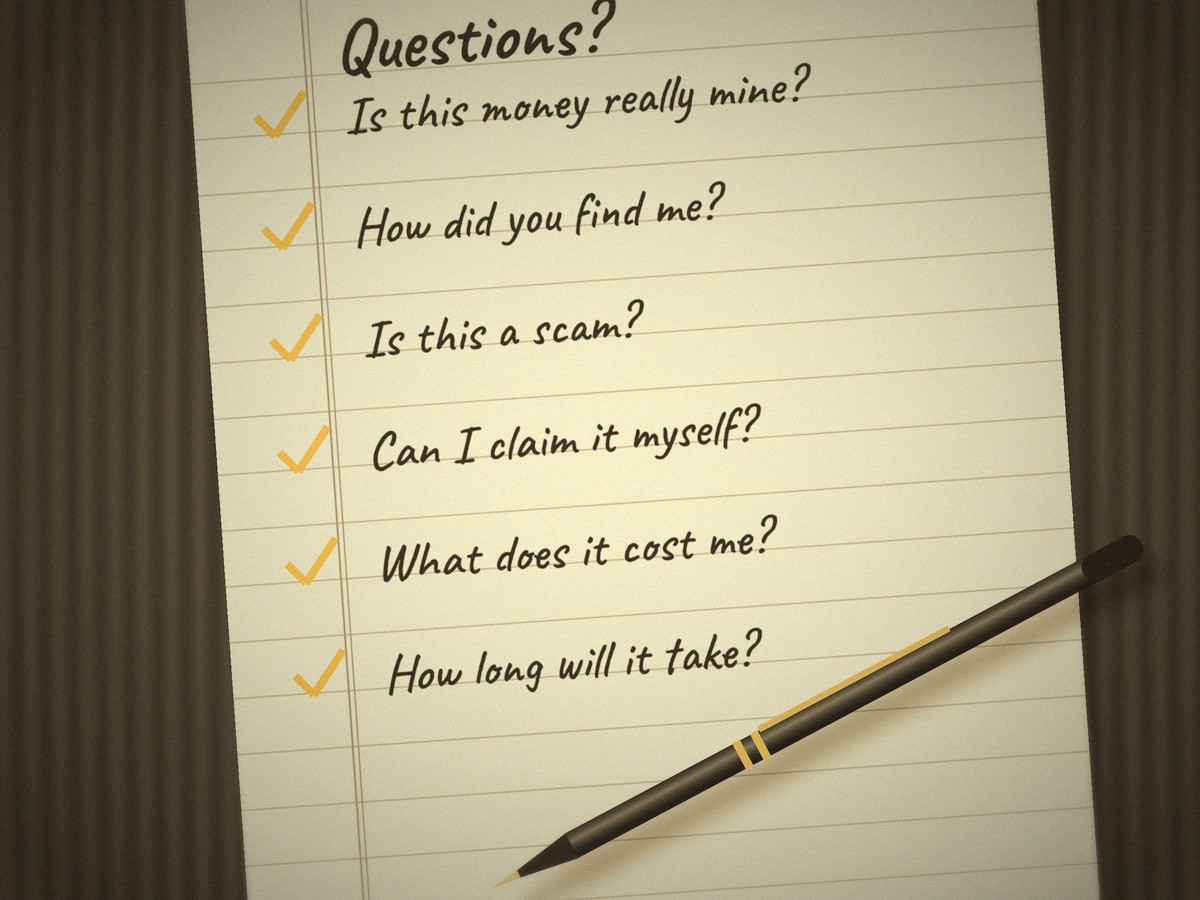
How did you find me / get my information?
We research public county and court records to identify properties that generated surplus funds. Then we use public-record lookup tools — the same kind of research many ordinary businesses use to verify who they’re doing business with — to find current contact information for the former owner. Ultimately, we use your information strictly to benefit you and get you the money you’re rightfully owed. Nothing else.
Is this a scam?
No — the money is real. It’s sitting with a county clerk or court, and it’s legally yours to claim. Here’s the truth about this industry, worth saying upfront: you don’t need us to get it. You’re always free to contact the county or court directly and file the claim yourself at no cost. We’re simply a paid option for people who’d rather not deal with the paperwork, deadlines, and back-and-forth themselves.
It’s worth being upfront about this too: county and court offices don’t always go out of their way to make this easy. Unclaimed money doesn’t vanish — it becomes part of their general funds. That’s less a knock on any one clerk than it is how the incentives are stacked. It’s exactly why we exist: to get that money back into your hands instead of leaving it there.
And on the fee: it’s a fixed percentage, spelled out in your agreement before you sign anything, and it will never exceed what your state’s law allows.
Can I just do this myself instead of paying you?
Yes. You can contact the clerk of court or county office handling your property’s sale, ask about surplus or overage funds, and file the claim yourself for free. If you’d like help — tracking deadlines, preparing the paperwork, and handling communication with the county — that’s what we offer, and we only get paid if you do.
What does it cost to work with you?
Nothing upfront. We work on contingency: our fee comes out of the funds we recover, and only if we recover any. You’ll see the exact fee in writing before you sign anything, with no surprises. That also means we only earn our fee by actually helping you. If we don’t believe taking on your case would be a real benefit to you, we’ll decline it and let you know — happily, and at no cost to you either way.
How long will it take to get my money?
It depends on the county and the type of sale, and whether anyone else has a claim on the same funds. We’ll give you a realistic estimate for your specific case once we start working on it.
What if I don’t want to move forward?
That’s entirely your call, no pressure. Reaching out to check doesn’t obligate you to anything.
Will you tell me if I’m better off not hiring you?
Yes — every time. If we look at your case and the numbers don’t make sense in your favor, we’ll say so directly, even though it means we walk away with nothing. We’re not chasing every case; we’re chasing the ones where we can actually make a real difference for you.